
Act Like a Marketer, Think Like...AI?
Why AI Search, AI Buyers, and AI Agents Are Really One Market Shift

Marketers keep getting handed a false choice this year.
Stay a marketer, or become a technologist.
Trust your instincts, or learn to prompt.
Run the playbook, or rip it up.
Pick a side. That’s the advice. And it’s wrong.
You keep every instinct that made you good. The instinctive read on what a buyer actually fears. The taste for a message that lands. The judgment to catch a number that’s lying. None of that expires.
You just add one thing: You learn to think the way AI thinks.
Why? Because a machine now sits in the space between you and every buyer you’re trying to reach, and it gets there first.
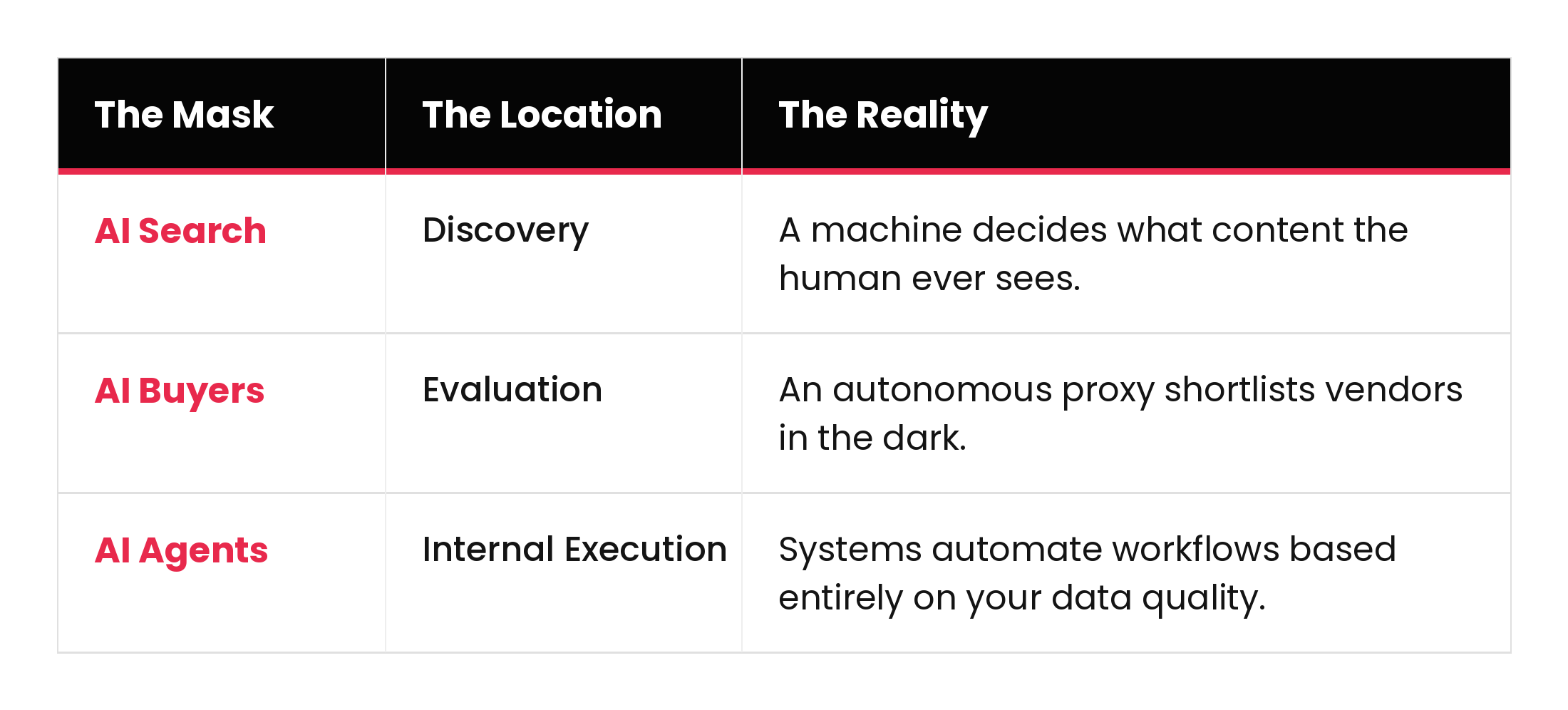
AI Search, AI Buyers, and AI Agents: One Shift, Three Places
Look at what people are actually worried about right now: Getting found in AI search, getting evaluated by AI buyers, and getting work done by AI agents.
Three trends. Three line items. Three vendors circling with three different decks.
But if you strip the labels off, it’s all one thing: A machine moved into the universe around your buyer, and it now reads, decides, and acts before any human does.
Marketing was never just about the buyer anyway; it’s about the universe around the buyer. The players, their incentives, the risk each one carries, and who signs the check. That universe just got a new resident, and the resident is a machine.
You don’t out-shout it. You think like it, and then you out-position everyone who didn’t bother.
Let’s pull each mask off.
1. To Get Found, Write for the Thing That Decides What the Reader Sees
Discovery is the loudest conversation right now. AEO, GEO, or whatever the acronym of the week is.
The numbers are too real to ignore:
Roughly 79% of B2B buyers now research through AI search.
Around 80% take the generated summary over a traditional list of links.
About 60% of searches end with a “zero-click” result.
Most advice treats this as a battle of New SEO vs. Old SEO. That’s the wrong altitude.
What actually changed is the order of readers. A model reads your content before a human ever gets the chance. The first reader you’re writing for isn’t your buyer; it’s the system deciding whether the buyer ever hears your name.
Act like a marketer: You still need a point of view sharp enough to be worth repeating. Nobody cites mush.
Think like AI: You structure that point of view so a machine can lift it cleanly, attribute it, and trust it.
Keep in mind that the machines don’t agree with each other. Claude leans on Brave. ChatGPT mirrors Bing. Perplexity chases whatever’s freshest. Gemini grounds itself in Google’s ecosystem and user engagement.
One asset, four referees, four rulebooks. Writing a single “AI-optimized” page for all of them is like pitching four entirely different buyers with a single script.
How do you solve this? You stop treating “AI” as a single monolith and start mapping your buyer to their specific engine of choice.
Just like you prioritize traditional marketing channels, you must identify which AI platform your specific audience trusts for their answers. If you sell to developers or technical researchers, they are likely running multi-layered queries in Claude or Perplexity. If you are selling to corporate procurement or enterprise executives, they are querying ChatGPT or encountering Gemini baked directly into their daily office applications.
Find out where your persona actually goes to ask their hardest questions, figure out that specific engine’s citation rules, and win that platform first.
2. The Buyer You’re Courting May Have Sent a Proxy
Here is the layer that empties the room of easy answers.
Your buyer is already doing the work in the dark. By the time they introduce themselves, something like 73% of the research is finished without you. You never even saw the room where it happened.
Now for the harder truth: The researcher isn’t always human. It’s an AI agent, sent ahead to parse, query, and return with a shortlist. The executive reads three names. The agent considered hundreds and cut yours before a human was ever involved.
One number makes this concrete: The 2X AI Innovation Lab ran an AI Visibility Index across 70 B2B companies and found that 96% of them were effectively invisible in early AI-driven discovery. Only about 4.3% turned up reliably when buyers asked the category-level questions that kick off a search.
The vanished 96% weren’t asleep. They were spending. But they built everything for a human buyer who types, clicks, and reads. An agent does none of those things. It queries APIs and parses documentation.
Act like a marketer: You know the core reasons a buyer picks you over the competition.
Think like AI: You make those reasons retrievable as structured, verifiable fact. Otherwise, the agent never surfaces them, and the human never learns you existed.
A great reason to buy your product that a machine cannot read is a reason that stopped counting.
3. An Agent is Only as Smart as the Universe You Hand It
The last mask is the one inside your own building.
The internal pitch sounds like absolute freedom: Agents scoring leads, orchestrating accounts, drafting first passes, and catching signals you’d otherwise miss. You stop doing the grueling execution and start directing it.
Then comes the sobering counter-stat: Gartner expects around 40% of agentic AI projects to be scrapped by the end of 2027. Not because the technology failed, but because of compounding costs, fuzzy value, and risks nobody planned for.
The failure here is a workflow and strategy problem, not a prompting problem.
Aim an agent at a vague goal with messy data, and it will produce expensive nonsense faster than any human could. But give it a mapped universe, one clear objective, and clean inputs? It will run the strategy you built flawlessly.
Act like a marketer: You map the universe, set the strategic goal, and retain the creative judgment that decides what “good” looks like.
Think like AI: You hand the agent a defined job and pristine material. It excels at execution; it does not strategize.
The cancelled projects almost always skipped the first half and blamed the second.
Three Masks. One Shift. One Posture.
Step back and look at the macro picture.
AI search. AI buyers. AI agents. Three separate line items, but the exact same mechanism operating in each: a machine reading, deciding, and acting before the human shows up.
The marketers who only act like marketers keep their taste but get out-retrieved.
The technologists who only think like AI ship clean structures with nothing worth retrieving, and get out-positioned.
The professionals who do both own the room where the decision now happens.
Credibility, connection, and conversions still run in that exact order. The machine has simply become the first audience you must earn credibility with before a single human gets a vote.
Stop choosing sides. Keep your instincts. Add the second mind.
Act like a marketer. Think like AI.
Differentiate, or disappear.
I take one of these mechanisms apart every week in The Marketing Lab, long before the rest of the market agrees on what it means. That’s where the next breakdown will be.